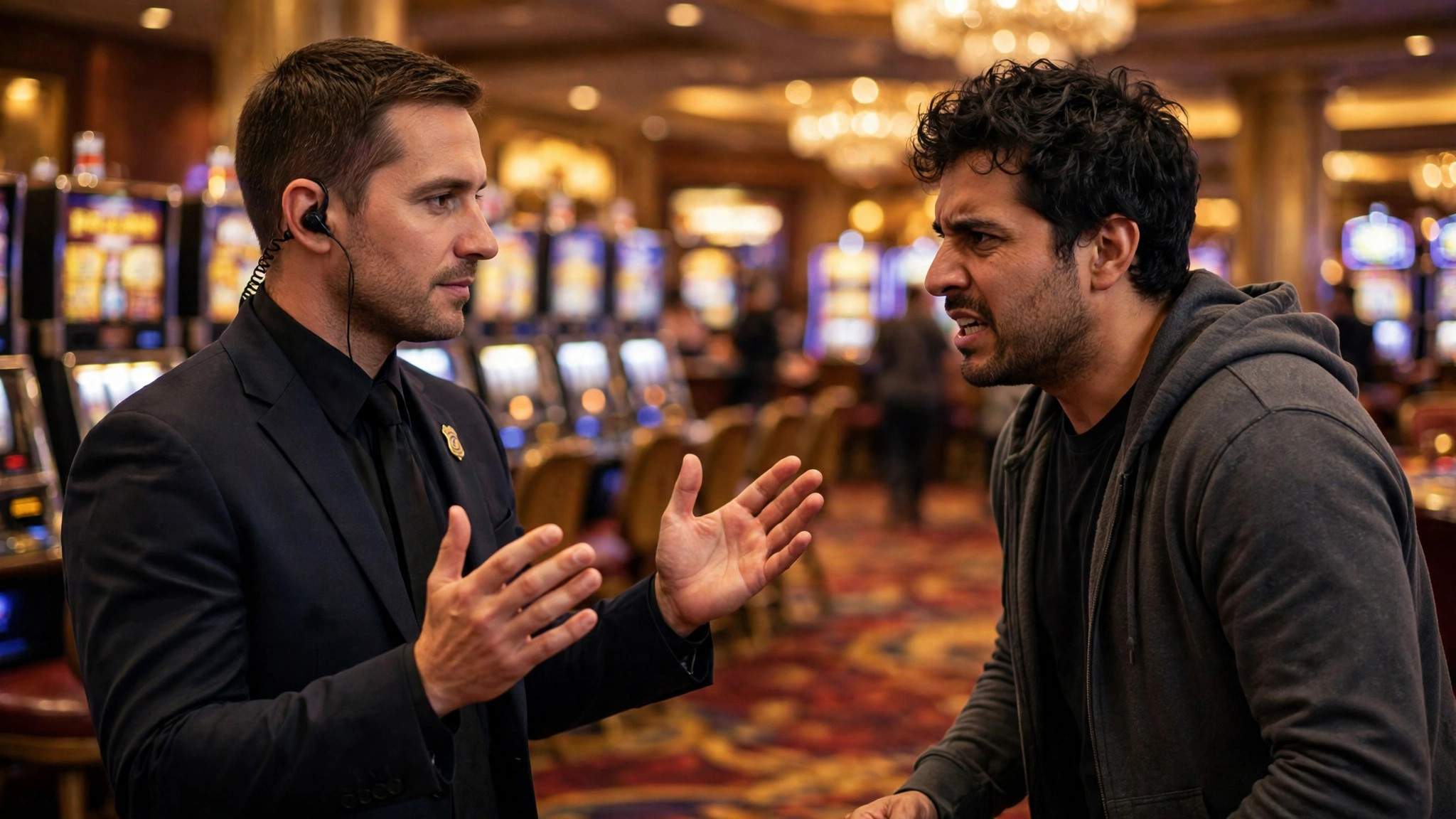

A Colorado man says a confrontation with MGM Grand security left him with a dislocated shoulder, a fractured arm — and a traumatic brain injury. His lawyers put past and anticipated medical costs at $166,815.50. MGM Grand denies every material allegation. And on October 2, the company moved the case from Nevada state court to federal court — only for a federal magistrate judge, four days later, to question whether it belonged there at all. (Casino.org; GambleRss)
The case — Lanctot v. MGM Grand Hotel, LLC — is still at the procedural stage. Nothing has been proven. But for every venue manager, casino operator, and employer with front-line staff, the lawsuit is worth studying right now. Not for the verdict, but for the claims: negligence, negligent hiring, training, supervision and retention, plus assault and battery. In other words, the plaintiff isn't just attacking what the officers did. He's attacking how they were trained. That's the part you can control.
I'm going to walk through the line between a lawful restraint and an excessive one — the way we teach it to venue teams in our Legal Aspects of Self-Defense program, from the perspective of law-enforcement veterans who have stood on both sides of this line.
Where the Line Sits
The legal rule is deceptively simple. When your staff uses physical force on a patron, employee, or trespasser, the force must be reasonable and proportionate to the threat — the minimum needed to gain control and end the danger. Everything past that point is not security work anymore. It's battery.
In the MGM case, the plaintiff alleges the officers went past that point: he was transported by ambulance, underwent a shoulder reduction under sedation, and was later diagnosed with a Bankart lesion, a Hill-Sachs deformity, and a mild traumatic brain injury with post-concussion syndrome. Whether those injuries came from excessive force or from a chaotic fight gone wrong is for the courts. But the shape of the dispute is familiar to anyone who has worked security: a routine encounter escalates in seconds, control is lost, and what follows is remembered very differently by each side.
That is exactly why the law doesn't grade you on what you meant to do. It grades you on what a reasonable person in the same situation would have done — and what your training records, your reports, and the cameras say.
The Trainer's Take: Lawsuits Are Lost in the 60 Seconds Nobody Documented
After three decades in law enforcement, I can tell you the use of force itself is rarely the whole story. The cases that ruin companies share a pattern: the physical part was brief, but the aftermath was sloppy. Nobody secured the witnesses. The report was written two shifts later, from memory. The cameras "didn't cover that angle." The involved staff talked to each other and harmonized their stories before anyone told them not to. And the training file was a stack of certificates with no evidence anyone ever practiced this scenario.
A well-trained team does five things — and four of them have nothing to do with technique.
1. Use only the force the moment requires — and stop the instant it isn't
Restraint is a tool, not a punishment. The force that is reasonable when someone is swinging at you becomes excessive the second he is on the ground and controlled. Officers must be trained to re-assess continuously: every few seconds, ask "is he still a threat?" If the answer is no, hands come off and the next phase — aid, communication, documentation — begins. The hardest thing to train isn't the takedown. It's the let-go.
2. Document the encounter while it's fresh — not tomorrow
Who did what, in what order, with what words spoken, witnessed by whom, on which camera. Write it within the hour. In the MGM litigation, expect every report, radio log, and second of video to be dissected — that's standard in a case like this. If your staff's habit is "we'll write it up at the end of the week," you are manufacturing exhibits for the other side. (See our breakdown of detention documentation for retail teams — the same discipline applies on the casino floor.)
3. Secure witnesses and video before they walk away
Bystanders leave. Patrons don't come back for your incident file. Someone on the team must own witness identification in the first minutes — names, statements, phone numbers — and someone else must own the video: preserve the relevant clips, note which cameras covered the scene, and pull footage before it is overwritten. In disputes like this one, the camera is often the only neutral witness in the room.
4. Train — and prove you trained
Read the claims in this lawsuit again: negligent hiring, training, supervision, and retention. Plaintiffs' lawyers don't attack training because it sounds bad; they attack it because juries understand it. "Show me the record of when your officers last practiced a restraint without injuring someone." A signed attendance sheet for a slideshow is not an answer. Scenario-based training, repeated regularly, with written after-action reviews — that is an answer. And if your records can't produce it, the jury will hear why.
5. Get them medical care fast — it protects both sides
When someone is injured during a restraint, call for medical help immediately, whether you think it's needed or not. It is the humane thing, and it is also the strategic thing: a prompt medical response defuses the claim that your people didn't care what they'd done. Note the time you called, who responded, and what was done.
What This Means for Your Venue
Note what the MGM dispute is really about. The encounter lasted minutes; the litigation will last years. The officers' employer is one of the largest casino companies in the world, and it is still spending real money defending this case — court filings, jurisdictional fights, the whole machinery. A mid-size venue doesn't have that machinery. One bad encounter with no training records and no documentation is an existential event, not a line item.
The good news: the prevention is trainable. A team that knows the force continuum, practices the restraint-and-release cycle under supervision, documents everything, and understands where its authority ends is dramatically harder to sue — and dramatically easier to defend.
Where Expert Consulting Fits
This is the core of our Legal Aspects of Self-Defense training: use-of-force boundaries, restraint standards, citizen's-arrest rules, and the documentation discipline courts expect — taught by law-enforcement veterans who have applied these rules under stress and testified about them after. We consult venue teams on the legal aspects of security work: what your people can and cannot do, and where the lines are.
One honest note: we are not a law firm, and this article is not legal advice. Train with us to know how to act inside the law; have your own attorney set your venue's final policies.
Lawsuits like this one are built in the minutes nobody rehearsed. If your team hasn't trained the restraint, the release, the witnesses, and the report, that training is overdue. Call +1 (530) 650-6306 to book an on-site session — or request a free consultation — before your venue becomes the case study.